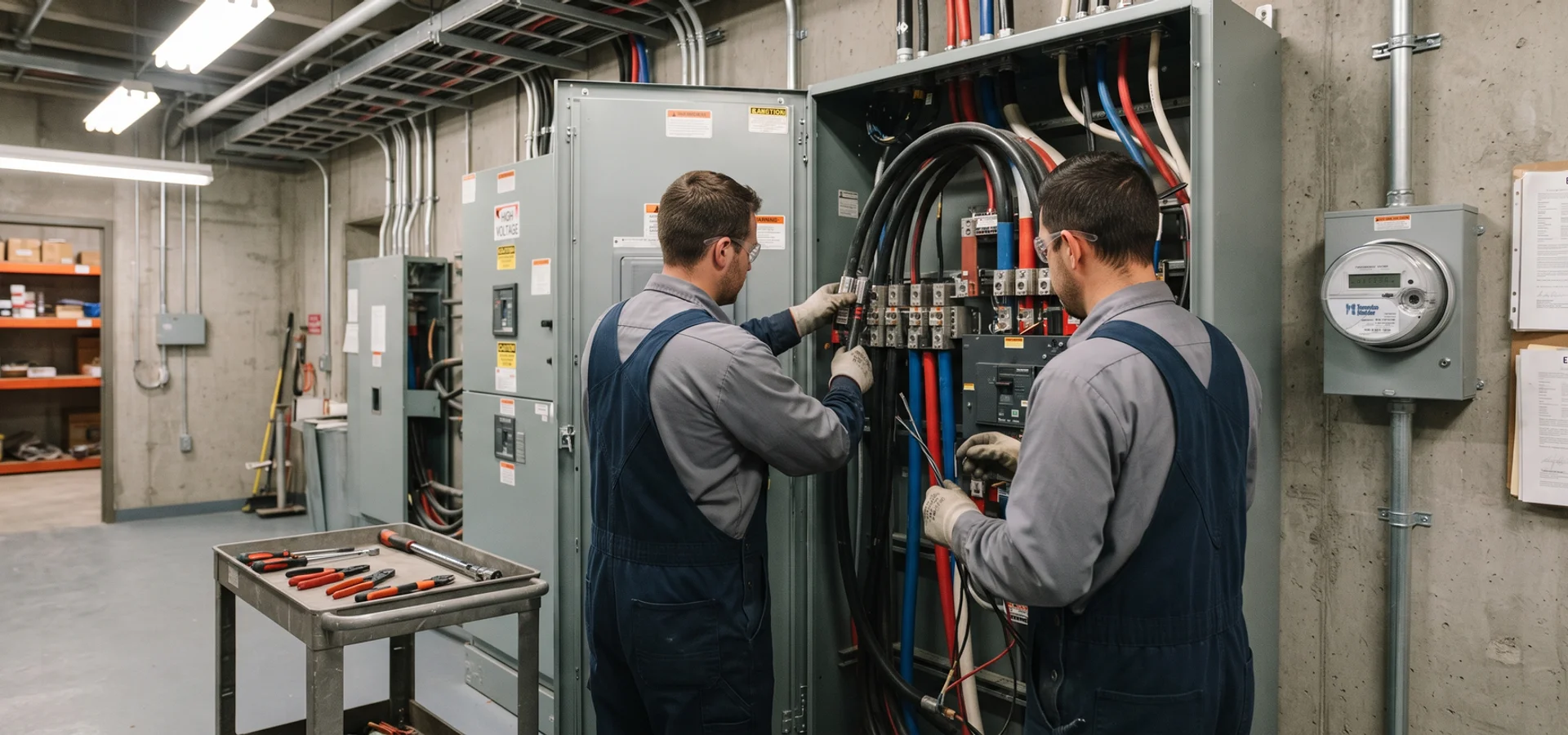
Crew terminating three-phase feeders into commercial switchgear

Three-Phase Electrical Service Upgrades in Toronto

Install or upgrade three-phase service (120/208V or 347/600V) for facilities with motor and equipment loads, with switchgear and a load study.

  • ECRA/ESA Licensed
  • ESA Permit Included
  • Utility Coordination Handled
  • Written Itemised Quote
Written itemised quote

$ 5,000 to $15,000 CAD

  • ESA permit filed and inspection booked
  • Utility disconnect and reconnect coordinated
  • Same-Week Scheduling
View Pricing Detail
  • ECRA/ESA Licensed
  • ESA Permit Included on Every Job
  • Same-Week Scheduling
  • WSIB Certified
  • Free Written Itemised Quote

What Is a Three-Phase Service Upgrade?

A three-phase service upgrade brings three-phase supply into a facility, or increases the capacity of an existing three-phase service, along with the switchgear and distribution to use it. In the Toronto area that means either 120/208V, which suits commercial equipment and smaller motors while providing standard 120V circuits directly, or 347/600V, which suits larger motor loads and long distribution runs with step-down transformers where lower voltage is needed. Both configurations are sized and terminated to the Ontario Electrical Safety Code (OESC).

The reason to move to three-phase is motor load. A three-phase motor draws balanced current across three conductors, starts more smoothly, and runs more efficiently than a comparable single-phase motor. For a facility running compressors, pumps, machine tools, conveyors or commercial refrigeration, three-phase is not a preference, it is what the equipment is built for.

Two things decide whether the project is straightforward or long. First, whether three-phase supply exists at your address, which varies street by street and is the first thing we confirm with the utility. Second, the utility’s own infrastructure work, because a transformer or primary extension has its own cost and timeline entirely outside the contractor scope.

For the industrial range, see industrial electrical panel upgrades.

Configuration Options

  • Three-phase distribution, supply already available. The existing service is three-phase and the work is switchgear and distribution capacity.
  • New three-phase service with switchgear. Converting a single-phase property where the utility can supply three-phase.
  • 347/600V service with transformer coordination. Higher voltage distribution with step-down transformers for 120/208V loads. See 600V electrical service upgrades.
  • Three-phase with motor control centres. Distribution plus the starters and controls the machinery needs.

When a Facility Needs Three-Phase

  • Three-phase equipment is being installed. Machine tools, compressors, larger HVAC and commercial refrigeration are usually specified for it.
  • Single-phase motors are tripping or running hot. A sign the load has outgrown the supply arrangement.
  • Distribution runs are long. Higher voltage and balanced current reduce conductor size and voltage drop across a large building.
  • A production line is expanding. Simultaneous motor starts change the demand profile, not just the total load. See manufacturing facility electrical upgrades.
  • Forklift or fleet charging is being added. Several chargers is a capacity and a distribution question. See warehouse electrical upgrades.

What Drives the Cost Between $5,000 and $15,000

Whether the supply already exists is the biggest factor in the contractor scope. Voltage class is second: 347/600V equipment and the step-down transformers that accompany it cost more than 120/208V. Switchgear size and section count is third, driven by how many feeders the facility needs. Cutover constraints are fourth, because a shutdown window or temporary supply both add cost.

Separate from all of this is the utility’s own work. A new transformer, a vault or a primary extension is priced by the utility and is frequently the largest single number in a three-phase project. We tell you that early rather than letting it appear late.

What to Expect Through the Project

The first phase is investigation and paperwork: the load study covering running currents, starting currents and duty cycles, the utility service application, and the commercial ESA plan review with the single-line diagram, equipment ratings and short-circuit current rating verification.

Installation normally happens alongside the existing system so the cutover is short. Switchgear is set, feeders are run to distribution panels and motor control, and terminations are torqued to specification. Before any motor is energized, phase rotation is verified and documented, because reversed rotation damages equipment on the first start.

The cutover runs in the agreed window, the ESA inspector attends, and the utility energizes. You receive the final single-line diagram, switchgear and panel schedules, the rotation and voltage verification records, the Certificate of Inspection and the itemised invoice.

How Much Does Three-Phase Upgrades Cost in Toronto?

Three-phase service work runs $5,000 to $15,000 CAD for the contractor scope. Utility transformer and primary infrastructure costs are separate and set by the utility.

Typical range

$ 5,000 to $15,000

varies by scope (CAD)

  • ESA permit fee included
  • Final ESA inspection included
  • Utility coordination itemised, never hidden
Get an Itemised Quote

What Moves the Price

Overhead mast or underground lateral

An underground service entrance needs trenching and civil work, so it sits higher in the range than a mast and weatherhead replacement.

Panel brand and circuit count

Siemens, Square D / Schneider Electric and Eaton load centres price differently, and a 42-circuit panel costs more than a small enclosure.

Service entrance length and routing

Conductor length from the meter base to the panel, plus any wall penetration or conduit work, changes the material and labour line.

Scope flagged by the load calculation

An OESC Section 8 result can add a subpanel, a grounding electrode conductor or a meter base that was not in the original plan.

Scope Low High
Three-phase distribution, supply already available $ 5,000 $ 9,000
New three-phase service with switchgear $ 8,000 $ 13,000
347/600V service with transformer coordination $ 11,000 $ 15,000

Why Choose Us for Three-Phase Upgrades?

ECRA/ESA licensed, permit filed, utility coordinated, quote itemised.

  • Supply confirmed before spec

    Whether three-phase exists at your address, and at what voltage, is confirmed with the utility before equipment is specified.

  • Motor loads calculated properly

    Starting current and duty cycle matter as much as nameplate running current. Both go into the study.

  • Phase rotation verified

    Rotation is checked and documented before motors are energized, because reversed rotation damages equipment on first start.

  • Production schedule respected

    Cutovers are planned around production or scheduled for a shutdown window agreed in advance.

How Does Three-Phase Upgrades Work?

The sequence every job follows, from the first load calculation to the utility reconnect.

  1. 01

    Load study

    Motor nameplates, starting currents, duty cycles and lighting load, assembled into a demand study with growth allowance.

  2. 02

    Utility supply confirmation

    Whether three-phase exists at the property, what voltage is available, and what transformer or primary work the utility requires.

  3. 03

    Plan review

    Single-line diagram, equipment ratings and short-circuit current rating submitted for commercial ESA plan review.

  4. 04

    Switchgear and distribution

    Switchgear set, feeders run to distribution and motor control, terminations torqued, phase rotation verified.

  5. 05

    Inspection and energization

    ESA inspection, utility energization, phase rotation and voltage verified under load before handover.

How Toronto Electrical Panel Upgrade Compares

Feature Typical provider Toronto Electrical Panel Upgrade
Load basis Nameplate running current only Running current, starting current and duty cycle
Utility supply Assumed available Confirmed with the utility before spec
Phase rotation Checked at first start Verified and documented before energizing motors
ESA plan review Client's responsibility Prepared and submitted by us

Need Three-Phase Upgrades in Toronto or the GTA?

Free on-site estimate, written itemised quote, ESA permit filed before the work starts.

Our Three-Phase Upgrades Work

Documentary photos from panel jobs across Toronto and the GTA. Select any image to enlarge it.

What Customers Say About Our Three-Phase Upgrades Work

Real Toronto and GTA neighbourhoods, real panel jobs.

They confirmed 120/208V three-phase was available at our address before we ordered equipment. The last quote we had assumed 600V was there.
Duncan R.Scarborough industrial area
Motor starting currents were in the load study, not just the running currents. That changed the feeder sizing and avoided a nuisance trip problem.
Olga M.Etobicoke
Phase rotation was verified and documented before anything was started. Our maintenance team appreciated getting that in writing.
Tariq A.North York

Three-Phase Upgrades FAQs

How much does a three-phase service upgrade cost in Toronto?

The contractor scope runs $5,000 to $15,000 CAD. Adding three-phase distribution where the supply already exists at the property sits at the lower end. A new three-phase service with switchgear, or a 347/600V service needing transformer coordination, moves toward the top. Utility transformer and primary infrastructure costs are separate and set by the utility, not by us.

Is three-phase available at my property?

That is the first question we answer, and the answer varies street by street across Toronto. Industrial and commercial corridors generally have it, mixed-use and residential streets often do not. We confirm with the utility what supply and voltage exists at your address before any equipment is specified, because a specification built on an assumption is an expensive mistake.

What is the difference between 120/208V and 347/600V?

120/208V three-phase suits commercial equipment, smaller motors and general distribution, and gives standard 120V circuits directly. 347/600V suits larger motor loads and long distribution runs because higher voltage means lower current and smaller conductors, with step-down transformers providing 120/208V where needed. Which one fits depends on your load profile and what the utility can supply. See [600V electrical service upgrades](/600v-electrical-service-upgrades/).

Why do motor loads need a load study?

Because running current is only part of the picture. Starting current can be several times running current, duty cycle affects heating, and simultaneous starts change the demand profile entirely. A study that only adds up nameplate running currents will undersize feeders and produce nuisance tripping the first time two machines start together.

What is short-circuit current rating and why check it?

SCCR is the maximum fault current equipment can safely interrupt. Available fault current rises as the service gets larger and closer to the utility transformer, so equipment that was adequately rated on an old service may not be on the new one. We verify available fault current against equipment ratings rather than trusting the label.

Can the upgrade happen without stopping production?

Often partially. New switchgear and distribution can usually be installed alongside the existing system, with the cutover scheduled for a planned shutdown or a weekend. Where a continuous process cannot be interrupted, temporary supply arrangements are priced as their own line.

What is phase rotation and why does it matter?

Phase rotation determines which direction three-phase motors turn. Reversed rotation can damage pumps, compressors and machine tools on the first start. We verify and document rotation before motors are energized, which is basic practice but frequently skipped.

Do you install motor control centres?

Yes, as part of industrial distribution scope. Motor control centres, starters and the feeders serving them are included where the project needs them. See [manufacturing facility electrical upgrades](/manufacturing-facility-electrical-upgrades/).

How long does the project take?

The install is measured in days to a couple of weeks depending on scope, but the project timeline is set by the utility service application, any transformer work and the ESA plan review, which are measured in weeks to months. We give you a schedule built on those dependencies.

What documentation do we get?

The final single-line diagram, panel and switchgear schedules, phase rotation and voltage verification records, the ESA Certificate of Inspection and the itemised invoice. Maintenance teams generally want the single-line and the schedules for the plant file.

Still have a question?

Ask the crew directly. We answer load calculation, permit and utility coordination questions before you commit to anything.

Same-Week Scheduling

Book Your Three-Phase Upgrades Estimate

Install or upgrade three-phase service (120/208V or 347/600V) for facilities with motor and equipment loads, with switchgear and a load study. Free on-site assessment across Toronto and the GTA.

  • ESA permit and final inspection included
  • Toronto Hydro coordination handled
  • No hidden fees on the written quote

Request a Written Itemised Quote

Four fields. We reply with a free on-site estimate date and the ESA permit and coordination fees broken out separately.

Prefer to talk? Call +1-647-577-6113

Call the Crew Free Estimate