What Is a Warehouse Electrical Upgrade?
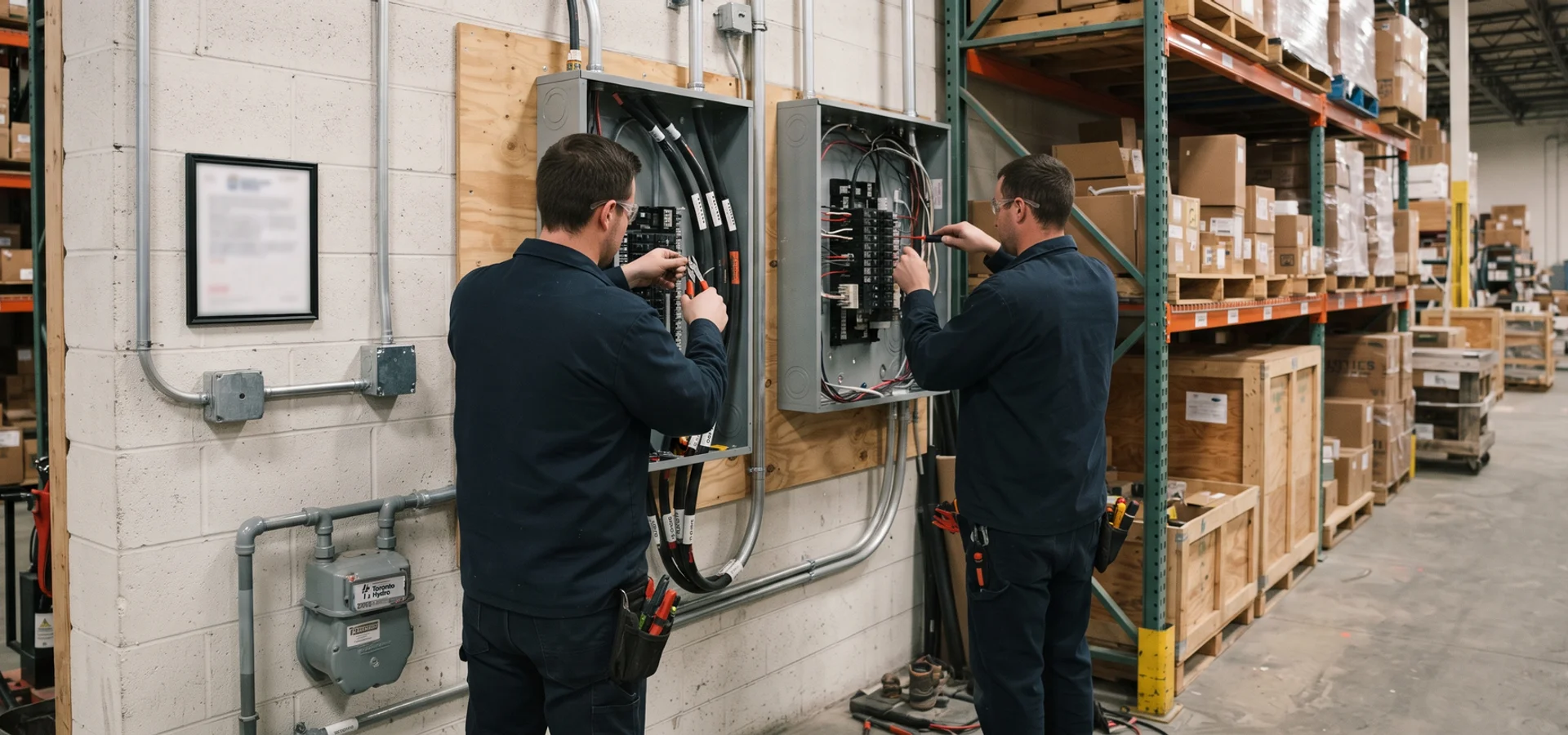
A warehouse electrical upgrade adds distribution capacity and reorganises it by zone, so equipment, charging bays and lighting can be powered where they actually sit. In most Toronto facilities the service itself is adequate and the real problem is distribution: one central panel installed when the building was built, with feeders stretched across the floor as equipment arrived. Every added subpanel and feeder still has to meet the Ontario Electrical Safety Code (OESC).
The typical scope is a set of subpanels positioned by zone, feeders sized for the equipment in each zone, dedicated circuits for forklift charging bays, and local disconnects at dock equipment and door operators. Where the load study shows the service genuinely cannot carry the facility, a service upgrade comes first.
Forklift charging deserves its own note. Chargers are long-duration loads running on shift patterns, so what matters is simultaneous demand rather than the sum of the nameplates. Calculated properly, a charging bay often needs less capacity than a nameplate total suggests, and a bay sized on nameplates alone can cost thousands more than it needs to.
For the industrial range, see industrial electrical panel upgrades.
Typical Scopes
- Zone distribution subpanels. Within existing service capacity. The most common and most useful scope.
- Forklift charging bay. Dedicated circuits, local disconnects and a demand profile built from your fleet and shift pattern.
- Service upgrade with zone distribution. Where the load study exceeds the existing service. See 200A to 400A service upgrades.
- Dock and door equipment circuits. Levellers, operators and restraints with local isolation.
- High-bay lighting circuits and controls. Circuit and control work coordinated with a lighting supplier.
When a Warehouse Needs Electrical Work
- A charging fleet is being added or expanded. The most common single trigger.
- Racking is being reconfigured. Feeders in the wrong place become a constraint on the new layout.
- Conveyor or automation equipment is going in. Motor loads that need correctly sized feeders and local isolation.
- Breakers trip when equipment starts together. Usually a distribution problem, not a service problem.
- New dock doors or levellers. Dedicated circuits and disconnects at each position.
- The panel has no spare positions. The reason every subsequent small change becomes a project.
What Drives the Cost Between $5,000 and $15,000
Number of zones and feeder runs leads, because each subpanel is a conduit route plus terminations at both ends, often at height. Charging bay size is second, driven by the simultaneous demand profile and the number of charger positions. Access requirements are third: lift access for high-bay runs and clear aisles both affect the schedule. Whether the service changes is fourth, since a service upgrade brings the utility, a CT cabinet and a plan review into scope.
The commercial ESA plan review and any lift access are itemised separately so the quote shows what each part costs.
What to Expect Through the Project
We start with the load study: equipment nameplates, the charging fleet and shift pattern, lighting, dock equipment and any process load, with demand factors and a growth allowance applied. From that we plan the zone distribution layout and prepare the single-line diagram for the commercial ESA plan review.
Installation is phased. Conduit and feeders go in aisle by aisle or zone by zone around your pick schedule and racking access, with lift access booked for high-bay runs. Subpanels are set at zone positions, circuits are run to charging bays and equipment, and local disconnects are installed where maintenance needs them.
The cutover happens in an agreed window. The ESA inspector attends, and you receive zone panel schedules posted at each panel, the final single-line diagram, the load study, the Certificate of Inspection and the itemised invoice for the facility file.